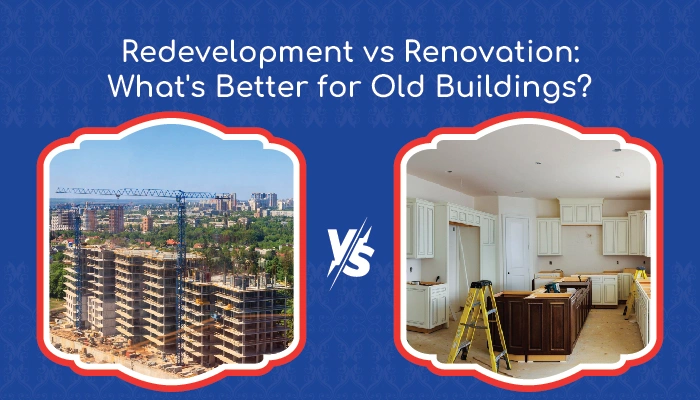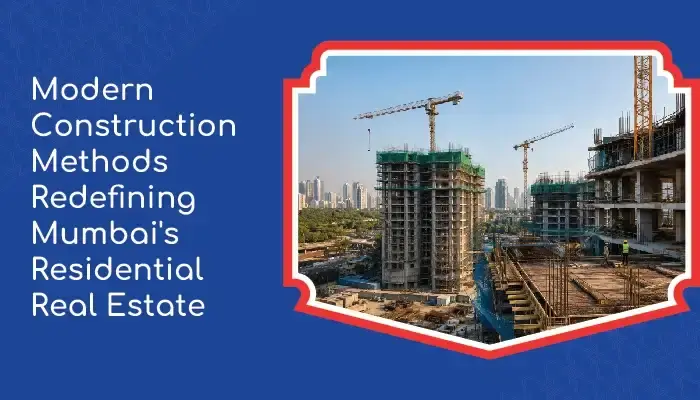
Mumbai’s residential real estate is changing faster than most buyers realise, and the shift is not just about design or location. It is happening at the construction level. The methods used to build residential projects in Mumbai today are fundamentally different from those that were standard a decade ago. Faster timelines, stronger structures, better finishes, and lower long-term maintenance are all outcomes of a construction industry that has had to evolve to meet the demands of one of the world’s most complex urban environments. This blog breaks down the modern construction methods driving that shift and what they mean for homebuyers.
Build with modern construction methods backed by decades of Mumbai expertise.
A] Why Are Modern Construction Methods Becoming the New Standard in Mumbai Real Estate?
Traditional construction methods were built for a different era. In Mumbai, where land is scarce, timelines are legally enforced, and weather conditions are extreme for a significant part of the year, the limitations of conventional building techniques have become increasingly difficult to work around.
The geography and climate of Mumbai necessitate that construction be carried out with precision. The high levels of humidity in the city, along with the monsoons and seismic activities, require building methods that provide reliable results based on uniformity in performance, rather than the unpredictability of craftsmanship. This is impossible using traditional construction techniques, which depend heavily on manual labour.
MahaRERA has further accelerated this shift. Legally binding possession timelines mean developers can no longer afford the delays that traditional methods routinely produce. Faster build cycles are now a business requirement, not just a quality aspiration.
The result is that innovative construction methods have moved from being a differentiator among premium developers to a default expectation across Mumbai’s residential market. For buyers exploring options with real estate builders & developers in Dadar, Mumbai, understanding what construction method underpins a project is now as important as evaluating the floor plan.
B] Which Modern Construction Methods Are Transforming Mumbai’s Residential Projects?
Several technologies have moved from pilot projects to mainstream adoption across Mumbai’s residential construction sector.
1. Mivan (Aluminium Formwork) Technology
Mivan technology involves the use of aluminium formworks to construct walls, slabs, columns, and beams at once. This will lead to the production of an RCC wall that features high levels of accuracy, joint lines that are very few, and a perfect finish, where the wall will not need plastering. In terms of high-rise housing construction in Mumbai, Mivan technology helps in saving time for each floor since the process will take about four to seven days only.
2. Precast Concrete Construction
Precast construction involves manufacturing structural elements, panels, staircases, and facades in a controlled factory environment before transporting them to the site for assembly. Because production happens off-site under precise quality controls, precast components are structurally superior to site-cast equivalents and arrive ready to install. For Mumbai’s congested construction sites, precast also reduces on-site activity, noise, and material storage requirements significantly.
3. Flat Slab Construction
The flat slab structural system does away with conventional beams that exist between the columns; therefore, the slabs can be made to span from one column directly to another. Such a construction technique results in the provision of uninterrupted ceilings as well as an increased height of the floors in terms of usable space, even though the total height of the building remains the same.
4. Twin-Wall Technology
The twin-wall system makes use of precast concrete wall panels with a central cavity filled with concrete at the site of erection. The process involves the strengths of both precast production and in-situ concrete systems, resulting in improved thermal properties, better sound insulation, and improved load-bearing capacity of walls. The system is especially suited for Mumbai’s high-rise residential structures, where acoustics and thermal comfort become major issues.
5. Sustainable and Green Construction Practices
Sustainable construction is increasingly embedded within modern building methods rather than treated as a separate consideration. Fly ash concrete, recycled aggregates, low-VOC materials, rainwater harvesting integration during construction, and solar-ready structural provisions are all becoming standard inclusions in Mumbai’s better residential projects. These choices reduce the environmental footprint of construction while also lowering the long-term operating costs of the finished building for residents.
C] What Are the Key Benefits of Modern Construction Methods for Mumbai Homebuyers?
The shift toward modern construction methods translates into tangible, measurable benefits for the people who ultimately live in these buildings.
1. Faster Possession Timelines
Reduced floor cycle times and off-site prefabrication allow developers to deliver projects significantly ahead of conventional schedules, which matters enormously for buyers planning around loan disbursements, school admissions, and rental commitments.
2. Better Structural Quality and Finish
Structural quality and surface finish are consistently higher with modern methods. Monolithic construction and factory-controlled precast elements eliminate the variability that manual site work introduces, producing buildings that are more uniform, more durable, and require less remediation after handover.
3. Superior Monsoon and Seismic Resilience
Mumbai’s monsoon and seismic conditions make structural resilience a genuine priority rather than a marketing point. Modern methods produce buildings that perform more reliably under both sustained moisture exposure and seismic loading than conventionally built structures.
4. Lower Long-Term Maintenance Costs
Better surface finishes, tighter structural tolerances, and integrated waterproofing systems reduce the frequency and cost of repairs across the building’s lifespan. For housing societies managing maintenance funds, this is a significant long-term financial advantage.
5. Energy Efficiency and Greener Living
Sustainable construction practices embedded within modern build methods, from fly ash concrete to solar-ready structural provisions, reduce the environmental footprint of the building and lower operating costs for residents over time.
D] How Are These Methods Shaping High-Rise Construction in Mumbai?
High-rise construction in Mumbai operates under engineering constraints that make modern methods not just preferable but necessary.
Vertical development beyond a certain height demands precision that conventional construction cannot consistently deliver. Wind load calculations, seismic performance requirements, and fire safety standards for tall buildings all require structural systems that perform predictably and uniformly across every floor of the building.
Building Information Modelling (BIM) has become an essential companion to modern physical construction methods in this context. BIM allows developers and structural engineers to model the entire building digitally before a single element is cast or installed, identifying clashes, optimising structural design, and coordinating MEP systems in a virtual environment. When combined with Mivan, precast, or flat slab construction on site, BIM dramatically reduces the gap between design intent and built outcome.
Mumbai’s FSI regulations also directly influence structural choices in high-rise development. Maximising usable carpet area within a given FSI envelope requires construction systems that minimise structural bulk, flat slab construction being the clearest example, while still meeting all applicable load and safety requirements. Modern construction methods are designed to solve exactly this problem. Buyers interested in how these standards are applied in practice can explore Harsh Group’s construction and real estate services for a closer look.
E] What Does the Future of Construction Technology Look Like for Mumbai Real Estate?
The construction industry trends shaping Mumbai’s residential sector over the next decade point toward further integration of technology at every stage of the build process.
1. 3D Volumetric and Modular Construction
3D volumetric construction and modular building are gaining ground internationally and are beginning to influence how developers in India think about off-site manufacturing at scale. Fully fitted modules, built and finished in a factory before being craned into position on site, represent the logical extension of the precast approach already taking hold in Mumbai.
2. Drone-Based Site Monitoring
Drone-based site monitoring is moving from novelty to standard practice, allowing project managers to track construction progress, identify deviations from design, and document site conditions with a frequency and accuracy that ground-based inspection cannot match.
3. AI-Powered Project Management
AI-powered project management tools are beginning to make meaningful contributions to schedule optimisation, procurement planning, and risk identification on large residential sites.
4. IoT-Enabled Structural Health Monitoring
IoT-enabled structural health monitoring, where sensors embedded in the building continuously track structural performance, load distribution, and environmental conditions, is the next frontier for residential buildings built to last across decades.
Explore Harsh Group’s residential projects built to the highest construction standards.
Conclusion
Modern construction methods are not a premium feature reserved for a handful of flagship developments. They are becoming the baseline expectation across Mumbai’s residential real estate market. For homebuyers, the shift means better-built homes, faster possession, and lower long-term costs. For developers who have adopted these methods seriously, it means buildings that stand up to Mumbai’s demanding conditions across decades. Contact us today to learn more about what this standard of construction looks like in practice.

Harsh Gupta
Harsh Gupta is a visionary architect based in Mumbai, dedicated to crafting homes that blend elegance, functionality, and modern living. As the Founder and CEO of Harsh Group, he brings over a decade of expertise in delivering high-quality residential projects across the city. Known for his commitment to timely delivery, transparency, and client satisfaction, he ensures every project reflects his passion for creating vibrant communities. His innovative designs and unwavering integrity have earned him the trust of countless homeowners, making Harsh Group a trusted name in redefining urban living in Mumbai.