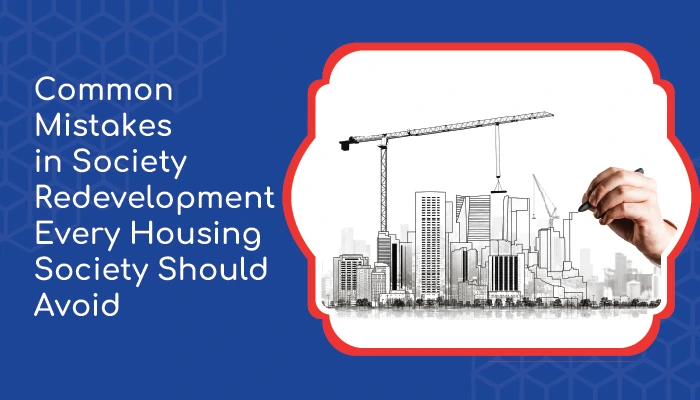
The redevelopment of a housing society is one of the most significant decisions it will ever make. It brings the promise of modern homes, better amenities, and improved living standards. But the journey from an ageing building to a new one is rarely straightforward. Many societies enter the process with optimism, only to face delays, disputes, and financial strain midway through. Most of these problems are not unavoidable. They originate from common mistakes in society redevelopment made at the planning stage or during execution. Understanding where things go wrong is the first step toward getting redevelopment right. This blog breaks down the key pitfalls and what every housing society should know before moving forward.
Get expert redevelopment guidance from Mumbai’s most trusted real estate builders.
A] Why Is the Redevelopment of Housing Societies a Complex Process?
The redevelopment of housing societies is not a simple construction project. This process is made up of many factors that need to be in harmony for it to work.
Redevelopment will need to coordinate efforts from individuals within society, management committees, developers, lawyers, and even the government. This makes decision-making more layered and time-consuming than most residents anticipate. A single point of disagreement can stall the entire project for months.
All rules of housing society redevelopment should also be complied with at each step of the process. From signing consent letters through to obtaining IODs and commencement certificates, there is much to be done legally.
Beyond paperwork, the decisions taken during redevelopment affect not just property value but also temporary relocation, transit rent timelines, and long-term living conditions for every resident. A poorly negotiated deal today can impact families for decades.
B] Common Mistakes in Society Redevelopment
Knowing what not to do is just as important as knowing the right steps. Here are the most frequent society redevelopment mistakes to avoid:
1. Inadequate Feasibility Study
Many societies skip or rush through a proper feasibility study before approaching developers. Without understanding the FSI potential, plot area, and existing legal status of the building, societies enter negotiations without the facts. This weakens their position and often leads to unfavourable agreements.
2. Selecting the Wrong Developer
Choosing a developer based solely on the highest offer is one of the costliest mistakes a society can make. A generous corpus amount or extra carpet area means little if the developer lacks the financial strength or execution track record to deliver. Always look beyond the numbers.
3. Lack of Transparency Among Members
Lack of transparency on the part of the managing committee leads to a lack of trust. Tensions arise, consensus becomes hard to achieve, and lawsuits may even be filed by members of the same society. Communication is non-negotiable; it is imperative.
4. Weak Legal Documentation
All three documents must be watertight in order to prevent any ambiguity on issues such as the commitment to carpet areas, possession deadlines, and rent payable during transit. In case of any problems, residents will have no legal way out.
5. Ignoring Compliance and Regulations
Redevelopment guidelines for housing societies are well-known in the state of Maharashtra; however, most societies either ignore them or are under the impression that all the work is taken care of by the developer. Failure to comply may lead to project halting, legal notice or even demolition of structures not authorised.
6. Unrealistic Expectations
Redevelopment is a process that requires patience. Setting expectations for occupancy within two years when the timeline should be four or five years is setting oneself up for failure. Societies must understand their timeline and plan appropriately.
7. Poor Financial Planning During Transit
The purpose of transit rent is to compensate for temporary housing expenses during the construction of the project. However, failure of proper negotiations and unrealistic calculation of rent will lead to residents having to pay extra out of their own pockets.
8. Delayed Decision-Making
Old and dilapidated buildings pose real safety risks. Prolonged indecision due to internal disagreements only increases vulnerability and adds to legal and structural complications. Societies must set clear timelines for decision-making and stick to them.
C] Key Factors in Redevelopment Projects That Societies Must Consider
Beyond avoiding mistakes, understanding the key factors in redevelopment projects helps societies make informed, confident choices.
1. Developer Credibility and Experience
A developer’s history speaks louder than any proposal. Review completed projects, speak to residents of previously redeveloped societies, and assess whether timelines were honoured and commitments were met.
2. Financial Stability of the Developer
A developer without secure financing is a risk. Societies should ask for proof of financial backing and check for existing lines on the developer’s assets. and verify that the project has a credible funding plan in place before construction begins.
3. Legal Clarity and Documentation
Every commitment made during negotiations must find its way into legally binding documents. Verbal assurances have no value. Ensure that a qualified legal advisor reviews all agreements before any member signs.
4. Project Timeline and Execution Plan
Ask the developer to present a detailed project schedule with clear milestones. A developer who cannot produce a structured execution plan is one who has not thought the project through.
D] How to Select a Redevelopment Developer?
Knowing how to select a redevelopment developer is one of the most important decisions a housing society will make. It is important to assess the track record of the developer through previous projects and reputation in the marketplace. It would be useful to visit some existing buildings of that developer and meet the people residing there, as well as visiting online developer forums.
Next, verify financial strength and registrations. Check mahaRERA listings, confirm RERA registration, and look into any legal disputes associated with the developer. Financial stability directly determines whether the projects will be delivered on time and to the promised standard.
Observe the communication skills of the developer when making the selection. Timeliness, clarity, and openness in answering tough questions can be considered qualities of a reliable partner. Finally, do not let large financial offers cloud the decision. A higher corpus or more carpet area means nothing without reliable delivery. Prioritise credibility and execution capability above everything else.
E] Housing Society Redevelopment Challenges You Should Be Prepared For
Even well-planned redevelopment projects face hurdles. Being aware of these housing society redevelopment challenges helps societies prepare rather than react.
Relocation is the first practical problem that arises for people. Securing temporary accommodation during the construction process may prove to be difficult, especially when it involves senior citizens and families with children. The transit rental should be settled according to the prevailing market trends, with escalation provisions being incorporated into projects that take more time than anticipated.
Coordination between the participants could also be another possible point of contention. Obtaining the consent needed to achieve the threshold is never an easy task when all parties are focused on their own agendas. However, appointing a neutral mediator or subcommittee for redevelopment can be helpful.
The regulatory and approval process is an inevitability. Approvals take time and can be unpredictable. Choosing to work with a developer with experience in dealing with the municipal authorities of Mumbai is an important distinction in handling such issues.
Protect your society’s future with the right developer and proper redevelopment planning.
Conclusion
Redevelopment is a once-in-a-generation opportunity for most housing societies. Done right, it transforms ageing buildings into modern, well-planned homes. Done poorly, it leads to years of stress, legal battles, and broken trust. The good news is that most mistakes are avoidable with the right knowledge, the right developer, and the right legal support. If your society is considering redevelopment, contact us for expert guidance. As trusted real estate builders in Mumbai, Harsh Group brings the credibility, experience, and transparency that redevelopment demands.

Harsh Gupta
Harsh Gupta is a visionary architect based in Mumbai, dedicated to crafting homes that blend elegance, functionality, and modern living. As the Founder and CEO of Harsh Group, he brings over a decade of expertise in delivering high-quality residential projects across the city. Known for his commitment to timely delivery, transparency, and client satisfaction, he ensures every project reflects his passion for creating vibrant communities. His innovative designs and unwavering integrity have earned him the trust of countless homeowners, making Harsh Group a trusted name in redefining urban living in Mumbai.